


Mukama Paul |
Technology-Facilitated Gender-Based Violence Must Not Be Faceless
She does not know it yet, but she has already been violated. The spyware was installed weeks ago. The deepfake has been circulating for three days. The threats are coming from an account that looks exactly like a colleague’s. In Uganda, for millions of women who live and work online, digital violence does not arrive with a warning. It arrives as silence — the sudden loss of a job, a suspended account, a door knocked on in the night.
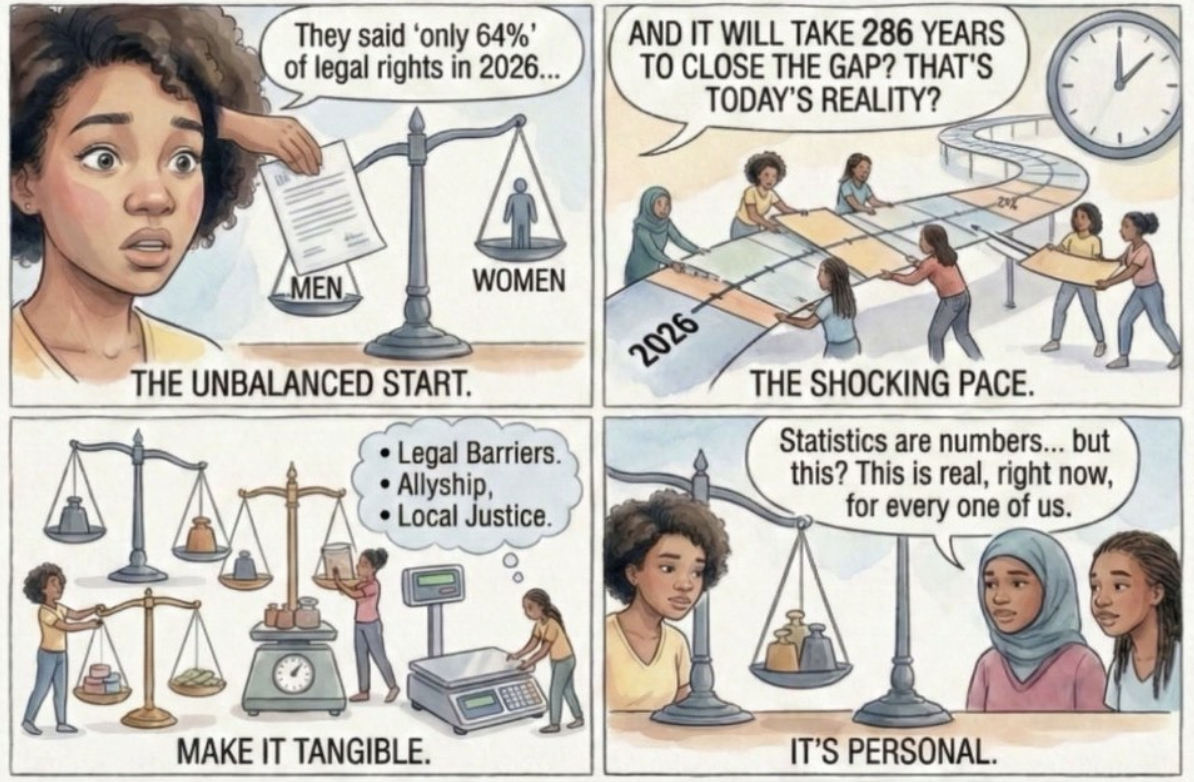
In commemoration of International Women’s Day 2026, under the United Nations theme “Rights. Justice. Action. For ALL Women and Girls,” Base Iota Foundation launched Scales of Change — a comic strip campaign confronting the urgent and persistently invisible crisis of Technology-Facilitated Gender-Based Violence (TFGBV) in Uganda. Produced in partnership with Femtech Law Initiative, HER Internet, and the Women of Uganda Network (WOUGNET), the series ran throughout March 2026, telling the stories of seven fictional but deeply grounded women whose lives were upended by digital violence.
The Scale of the Problem
Technology-Facilitated Gender-Based Violence (TFGBV) refers to any act of gender-based violence committed, amplified, or facilitated through digital technologies — from smartphones and social media platforms to spyware and artificial intelligence. In Uganda and across sub-Saharan Africa, the problem is both pervasive and profoundly underreported.
Research by the African Declaration on Internet Rights and Freedoms indicates that women in Africa are disproportionately targeted online, with gender-based harassment, non-consensual image sharing, and doxxing rising sharply alongside internet penetration. A 2022 resolution by the African Commission on Human and Peoples’ Rights further recognised digital violence as a continent-wide protection crisis requiring urgent legal remedy.
Uganda’s internet user base has grown to over 14 million — roughly 28 percent of the population — yet digital safety infrastructure and legal frameworks have not kept pace. A 2020 survey by Pollicy found that nearly one in three Ugandan women who use the internet had experienced some form of online gender-based harassment, a figure that more recent research suggests has grown significantly. For women in public life — politicians, artists, activists, journalists, and content creators — the risk is exponentially higher.
The documented cases are instructive. In 2014, singer Desire Luzinda became one of the earliest widely publicised victims when an ex-boyfriend leaked her private images, triggering a social media pile-on that compounded rather than acknowledged her distress. A year later, media personality Anitah Fabiola suffered a similar fate and was dismissed from her job as a direct result — a stark illustration of the professional destruction that follows victims. In 2018, model Judith Heard’s images were leaked after her device was stolen; in a troubling inversion of justice, it was she who was arrested and charged under the Anti-Pornography Act — a law that punished the victim rather than the perpetrator. Then in 2019, radio presenter and comedian Martha Kay endured months of extortion after her phones were stolen, paying a ransom only to have the images leaked regardless.
What makes TFGBV particularly insidious is its invisibility. A spyware app installed on a phone leaves no visible trace. A deepfake video travels faster than any correction. A coordinated mass-reporting campaign can get a woman’s account suspended within hours, turning the platform’s own moderation tools into a weapon against her. These are not edge cases. They are documented patterns — and they are the patterns that Scales of Change sets out to expose.
Seven Women, Seven Forms of Violence
The series introduces seven distinct fictional personas, each carrying a different manifestation of digital violence, whose stories unfolded across four campaign phases throughout March 2026: Rights, Justice, Action, and For All. Each arc was designed not only to name the violence but to show its resolution — because survival and resistance, not only suffering, belong in the record.
Nankya, a 42-year-old Member of Parliament, confronts the non-consensual sharing of intimate images deployed as political sabotage days before a committee vote. Her arc refuses victimhood: she proceeds with the vote, wins it, and then stands on the floor of Parliament to demand legislative reform.
Bukirwa, a 29-year-old human rights defender from Wakiso, experiences the full force of a coordinated online pile-on after naming a prominent perpetrator of gender-based violence. Fabricated screenshots, mass false reports, and threats flood her mentions within hours, getting her account suspended. Her response is meticulous documentation, solidarity networks, and a single defiant return post — a demonstration that even imperfect systems can be navigated with the right tools and community.
Nakigudde, a 25-year-old content creator with over 80,000 followers, wakes up to discover that a deepfake video using her face has already reached her brand partners’ inboxes before she even knows it exists. Three sponsors suspend contracts. The platform eventually removes the video after five days and hundreds of thousands of views. Her story illustrates the devastating intersection of emerging AI tools and the economic precarity faced by women who have built livelihoods on digital platforms.
Nalongo, a 35-year-old LGBTQ+ activist and community organiser from Entebbe, comes out publicly on her own terms — only to have anti-LGBTQ+ networks publish her home address, her children’s school, her employer’s contact, and her family members’ names within days. Her story names doxxing for what it is: a tool of political suppression, not merely personal attack.
Sarah, a professional navigating intimate partner digital surveillance, has spyware secretly installed on her devices by a partner who tracks her location, monitors her messages, and uses the information to control her movements and finances. Her story, set partly in Kampala’s markets and conference centres, exposes covert monitoring as one of the most underreported forms of TFGBV — invisible by design, devastating in cumulative effect, and almost never prosecuted.
Awila, a 22-year-old TikTok creator originally from Gulu, is targeted through a sophisticated sextortion scheme — a fake brand manager who spends weeks building trust before issuing demands. She does not pay. With support, she reports, secures her accounts, and records a video warning that reaches 200,000 people. Her arc carries the campaign’s sharpest lesson: sextortion does not happen to the careless. It happens to women who were targeted by skilled predators, and the blame belongs entirely with the perpetrator.
Sofia, a 38-year-old human rights lawyer in Kampala, receives a message referencing the coffee shop she visited that morning — from an unknown sender who has been tracking her location. A woman who has spent her career helping others name their violations finds it hardest to name her own. Her eventual resolution — securing her devices, reporting to the Uganda Police Cybercrime Unit, and submitting to a legal reform consultation on digital stalking as institutional intimidation — is both personal and political. Her case closes the loop on the series’ central argument: that the law must catch up with the weapon being used against women, and that even those trained to invoke the law need community to find their way back to it.
Tipping the Scale
Technology-facilitated gender-based violence in Uganda is not a fringe issue. It cuts across every layer of society, affecting parliamentarians and factory workers, LGBTQ+ organisers and content creators, lawyers and community activists alike. It is used to silence, to punish visibility, and to push women out of public and digital spaces. It exploits the same platforms that have expanded access, connection, and livelihood for millions — and it does so with near-total impunity.
All seven story arcs will be compiled into a digital comic book, designed to extend the campaign’s reach beyond March 2026. The collection will be distributed through schools, legal aid clinics, digital rights workshops, and community WhatsApp networks — ensuring the stories of Nankya, Bukirwa, Nakigudde, Nalongo, Sarah, Awila, and Sofia reach the women who most need to see themselves in them.
But the work does not end with distribution. What Scales of Change ultimately argues is that visibility is the first act of justice. These seven women — fictional in name, deeply real in circumstance — represent the hundreds of thousands of Ugandan women for whom TFGBV remains unnamed, unreported, and unprosecuted. To see the violence clearly is to begin to dismantle it. The scale of the problem demands nothing less.